
Most emergency guides focus on 72-hour home kits and “go bags”. Those are essential, but they are not with you when the train stops in a tunnel, the lights go out in a car park, or your phone dies during a medical incident.
Everyday carry (EDC) bridges that gap. The goal is a small set of tools you actually carry in a pocket or small bag every day, not a rucksack full of unused gear.
US guidance from FEMA’s Ready campaign and the American Red Cross consistently highlights core items like a torch/flashlight, first-aid supplies, battery-powered radio, and spare power for phones in their emergency kit checklists. This post scales those ideas down to a realistic urban EDC Carry Bag.
Principles for a practical EDC Carry Bag
Before individual items, set a few rules:
- Small and lightweight
If it does not fit into your normal pockets or a compact pouch, you will stop carrying it. - Used in everyday life
Gear that is useful in minor, everyday situations is more likely to stay with you. A torch for dark stairwells, a power bank for low phone battery, plasters for minor cuts. - Legal and workplace-friendly
Some tools (especially blades) are restricted in certain jurisdictions and workplaces. Check local laws and policies before choosing a multitool. - Simple to maintain
Fewer batteries to manage, standard charging cables, no complicated maintenance routines.
With that framework, you can build a kit that supports both routine inconveniences and genuine emergencies.
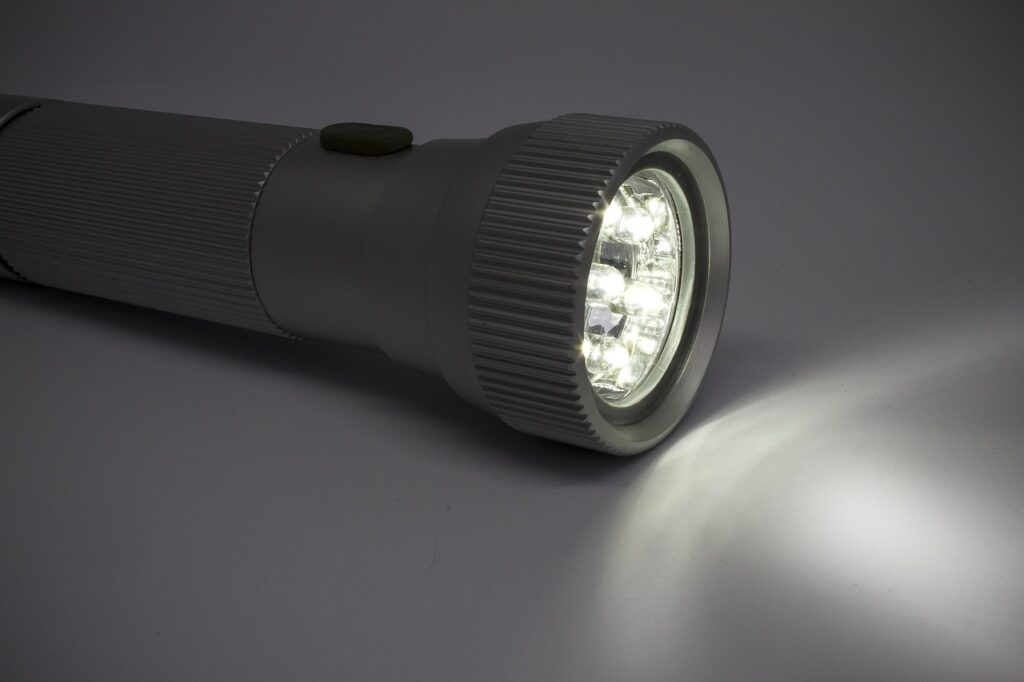
Core item 1: Small torch (flashlight)
Major US emergency kit checklists all include a torch/flashlight with spare batteries as a basic requirement. At EDC scale, that means a compact LED torch you can clip to a pocket or keyring.
Uses:
- Power cuts in stairwells, basements, and lifts
- Navigating poorly lit streets or car parks
- Signalling in smoke or low-visibility environments
- Reading maps or instructions in the dark without draining your phone battery
Look for:
- Single AA/AAA or built-in rechargeable battery
- Simple interface (one or two brightness levels, not a complex mode menu)
- Pocket clip or keyring attachment
- You are trading “tactical” features for reliability and ease of use.
Core item 2: Power bank and cable
In an urban environment, your phone is your primary emergency tool: it carries contacts, maps, translation, payment, and access to emergency alerts. Several US public health and emergency-preparedness resources explicitly recommend having backup power for phones and other essentials.
For EDC, a power bank should be:
- Roughly 5,000–10,000 mAh (enough for 1–2 full recharges for a typical smartphone)
- Flat or slim enough to fit in a pocket or small organiser
- Charged on a schedule (for example, top up every Sunday night)
Add a short charging cable that matches your phone (and ideally a multi-tip cable if your family uses mixed devices). The aim is to keep your phone usable during extended disruption, not to run a laptop.
Core item 3: Compact first-aid
The American Red Cross places first-aid kits high on its emergency supply lists, for both home and “on-the-go” use. For an urban EDC carry bag, scale this down to a “pocket trauma-lite” kit:
Include:
- Assorted plasters/band-aids
- A small sterile dressing or gauze pads
- Alcohol or antiseptic wipes
- A pair of nitrile gloves
- Any critical personal medication (e.g. a spare inhaler, EpiPen, or tablets your physician has advised you to carry)
Keep it in a flat, tough pouch so it does not get crushed. The goal is to manage minor injuries immediately and stabilise more serious ones until professional help arrives.
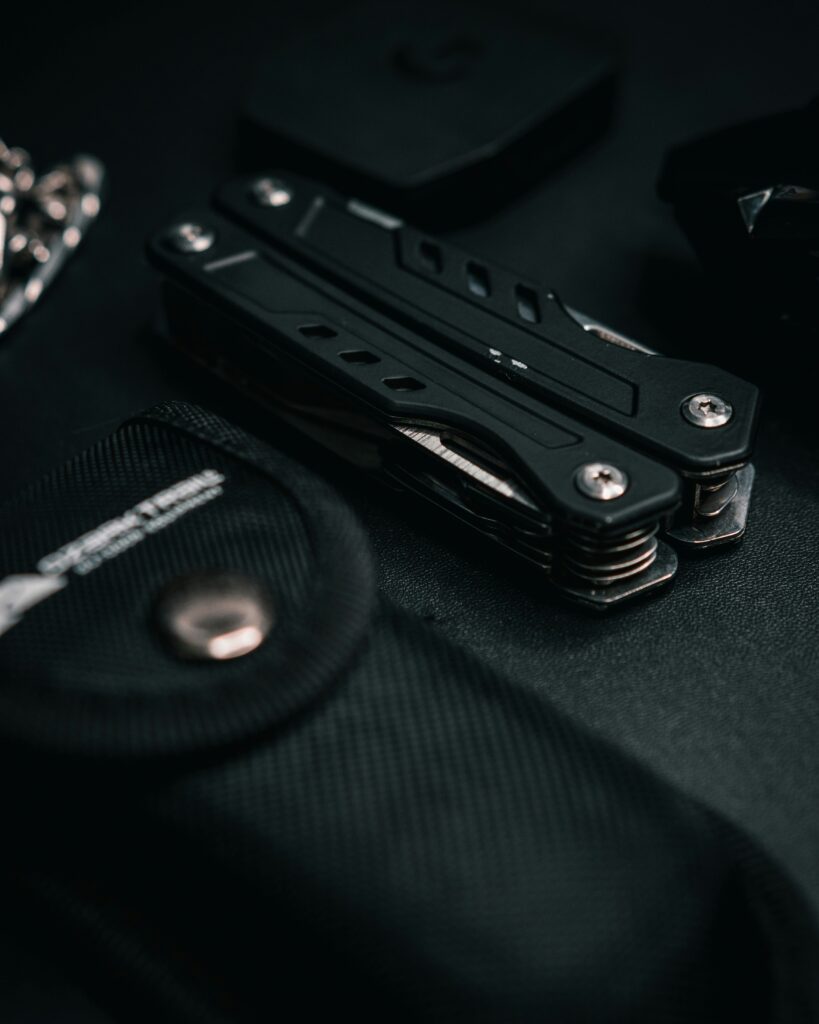
Core item 4: Multitool (where legal)
A small multitool can handle a range of minor problems: cutting tape, opening packaging, tightening screws, pulling a bent clip, or cutting a seat belt after a collision.
Options:
- Knife-free multitool (scissors, screwdrivers, pry tool, file) for workplaces or jurisdictions with strict blade rules
- Compact pliers-based multitool for those who can legally carry a small blade
Check:
Local and state laws on blade length and carry restrictions
- Workplace policies on tools and sharp objects
- The multitool should live in the same pocket or organiser every day, so you know exactly where it is when needed.
Core item 5: Notepad and pen
Digital tools fail when batteries die, screens crack, or networks go down. A small notepad and a reliable pen solve several problems:
- Writing down addresses or directions if your phone battery is low
- Passing information to responders or other people (“Medication list inside jacket pocket”, “Family meeting at X”)
- Recording licence plates, witness details, or times after an incident
Choose a pocket notebook and a pen that can write on slightly damp or dirty paper. Keep them together inside a small zip bag if you live in a wet climate.
Optional: Pocket radio as an information lifeline
Emergency guidance from CDC, Ready.gov, and the Red Cross all highlight battery-powered or hand-crank radios, ideally with NOAA Weather Radio capability, as key items to receive alerts during disasters.
For most people, a full-size emergency radio belongs in a home or vehicle kit, not in a pocket. If you want radio capability in your urban EDC:
- Look for a very small AM/FM/NOAA receiver or a combined torch/radio unit
- Prefer models that charge over USB so you can use your power bank
- Accept that this is an optional “upgrade” once you are already carrying the core items
The value is simple: when mobile networks are overloaded or down, broadcast radio often remains the most reliable way to receive official information and instructions.
How to carry it: pockets, pouch, or small bag
To keep the kit truly everyday:
- On-body pockets: torch, notepad, pen, possibly a very small multitool
- Small organiser pouch: power bank, charging cable, compact first-aid, slightly larger multitool, any optional radio
- Day bag or work bag: the pouch drops straight in so you can change bags without repacking
The entire setup should be light enough that you do not notice it after a week. If you do, reduce bulk until it becomes habit.
Maintenance in minutes
US emergency kit checklists recommend reviewing supplies at least annually and rotating perishable items and batteries. For EDC, shorter intervals make sense because batteries and power banks are used more often.
Set a simple schedule:
- Once a month:
- Recharge the power bank
- Check torch operation
- Replace used first-aid items
- Once or twice a year:
- Review medications’ expiry dates and replace as advised by your healthcare provider
- Inspect any multitool for wear or damage
You now have a compact, realistic urban EDC carry bag that aligns with the priorities in national US preparedness guidance but remains small enough to carry every day.
Further reading (US-focused)
Ready.gov – Build a Kit: official FEMA guidance and checklists for full emergency supply kits, including torches, radios, first-aid, and more.
https://www.ready.gov/kit
American Red Cross – Survival Kit Supplies: recommended supplies and principles for building emergency kits that can be used at home or taken with you.
https://www.redcross.org/get-help/how-to-prepare-for-emergencies/survival-kit-supplies.html
CDC – Build an Emergency Kit: public health perspective on essential safety items, including first-aid kits, radios, and torches.
https://www.cdc.gov/natural-disasters/psa-toolkit/build-an-emergency-kit.html